Why Your Allergy Medication Seems to Stop Working (It's Not Actually Losing Effectiveness)
Quick Answer: If your 24 hour allergy medicine is not working anymore, true tolerance is rarely the cause — research on standard second-generation antihistamines (cetirizine, loratadine, fexofenadine) doesn’t show meaningful tolerance building over years. What usually changed is the pollen load, a newly developed sensitivity, your home environment, or your dosing consistency. Fix those four before you switch brands.
You took the same pill every spring for six years and it worked. This year you’re on day nine of the same dose and your eyes still itch by 3 p.m. The obvious conclusion — “my body got used to it” — is also the wrong one most of the time.
That matters, because the wrong diagnosis leads to the wrong fix. People spend three seasons brand-hopping between the exact same drug class while the actual culprit sits untouched in the backyard.
This article is general information, not medical advice.

Do antihistamines stop working over time?
Not in the way most people mean. Genuine pharmacological tolerance — where receptors downregulate and the same dose produces less effect — is well documented for some drug categories, but it’s uncommon with the second-generation antihistamines sitting in your medicine cabinet.
The sensation of failure is real. The explanation just isn’t the drug.
Here’s the practical version: if your medication “quit,” something in the equation around it changed. There are four suspects, and you can check all four in about a week.
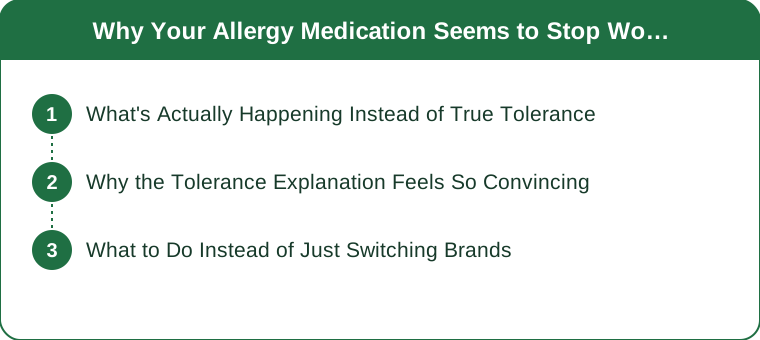
What’s actually happening instead of true tolerance
The pollen load got heavier. Local pollen counts swing enormously year to year — a heavy tree-pollen spring can run several times the concentration of a mild one. The same dose that comfortably handled a light season gets overwhelmed by a heavy one. The season changed, not the drug.
You developed a new sensitivity. Allergies aren’t fixed at birth. Adults regularly become sensitized to something new — a grass, a mold, a pet dander — years into stable treatment. Your antihistamine was never treating this new trigger, so of course it doesn’t cover it now.
Your environment changed. A new cat, a move across town, fresh landscaping next door, a different HVAC filter. Each of these adds an allergen load your old regimen never had to carry.
Your timing drifted. This one is boring and extremely common. Antihistamines work best at steady state, meaning consistent daily dosing. Taking it at 8 a.m. some days and 6 p.m. others, or skipping a day here and there, quietly undermines the effect. Most people who “know” they take it daily are actually at 4 or 5 days out of 7.

Myth vs Fact
Myth: “You need to rotate antihistamines every few months to prevent tolerance.” Fact: Evidence for rotation preventing tolerance is thin. What rotation reliably does is give you a fresh start psychologically — and often coincides with a lower-pollen week, which gets miscredited to the new bottle.
Myth: “If it stopped working, take two.” Fact: Doubling up on your own is a conversation for a clinician, not a self-experiment. Some antihistamines cause noticeable sedation at higher doses, and doubling doesn’t address a new trigger at all.
Myth: “Switching from loratadine to cetirizine is switching drugs.” Fact: Both are second-generation antihistamines doing the same job through the same mechanism. Individual response does vary, so a switch is worth one honest trial — but if the real problem is a new cat, you’ll get the same disappointment in a different box.
Myth: “Symptoms getting worse means the allergy got worse.” Fact: It can also mean exposure got worse. Same allergy, more of it.
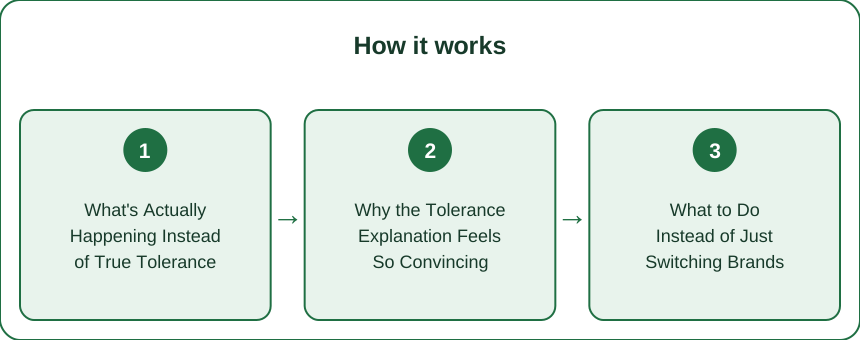
Why the tolerance explanation feels so convincing
The timeline does the work. You’ve been on the medication for years, and now symptoms are worse — the causal story writes itself even when the cause is elsewhere. Correlation reads as causation, especially when you’re miserable.
“It stopped working” is also just a simpler story than “my pollen exposure changed and I may have picked up a new sensitivity.” Simple stories win, even when they’re wrong.
Then brand-switching confirms it. You switch, the next week happens to be rainy and low-pollen, you feel better, and the tolerance theory gets a gold star it didn’t earn. (Rain is the most underrated allergy medication on the market, and it’s free.)
Finally, there’s the psychology of blame. “My body adapted” feels fixable. “My environment changed in ways I can’t fully control” does not. People reach for the actionable villain.
What to do instead of just switching brands
1. Correlate with real data first. Check a local pollen tracker for the past two weeks against the days your symptoms spiked. If your bad days line up with high counts, your medication didn’t fail — it got outnumbered.
2. Audit your own consistency for 7 days. Same time each day, no skips, written down. Set a phone alarm. A full week of genuinely consistent dosing is the cheapest test you can run, and it resolves a meaningful share of “it stopped working” cases on its own.
3. Hunt for the new trigger. New pet, new apartment, new job with a different building, new bedding, new landscaping. Write down what changed in the last 12 months. A new trigger needs a different approach, not a different antihistamine.
4. Ask about testing rather than guessing. If symptoms genuinely shifted — new symptoms, different timing, different body parts — retesting for sensitivities tells you more than another six months of brand roulette.
5. Consider adding rather than swapping. For many people, a nasal steroid spray plus an oral antihistamine covers what either does alone, particularly for congestion, which oral antihistamines handle poorly. That’s a conversation with a pharmacist or clinician.
When to see a professional
See a clinician if symptoms include wheezing or shortness of breath, if over-the-counter treatment stops controlling symptoms enough to sleep or work, if you’re using medication daily for months on end without a plan, or if you’re considering doubling a dose. Sudden facial swelling or trouble breathing is an emergency, not an allergy season inconvenience.
FAQ
Can you build a tolerance to Zyrtec or Claritin?
Meaningful pharmacological tolerance to second-generation antihistamines is uncommon in the research. Individual response varies, and some people genuinely respond better to one molecule than another — but if a medication “stops working” after years, look at exposure and consistency first.
Why does my allergy medicine work in the morning but not at night?
Often a timing and steady-state issue, and sometimes an exposure one — indoor allergens like dust mites and pet dander peak in the bedroom. Try consistent dosing at the same hour daily for a week, and look at what’s in your sleeping environment.
Is it bad to take allergy medicine every day?
Many people take second-generation antihistamines daily through their season, and that’s a common approach — but daily long-term use is worth a conversation with a clinician or pharmacist rather than an indefinite default, especially if you’re not getting the relief you expect.
TL;DR:
- Real tolerance to standard antihistamines is uncommon — “it stopped working” almost always means something else changed.
- The four usual suspects: heavier pollen season, a newly developed sensitivity, a changed home environment, drifted dosing timing.
- Brand-switching feels effective because it often coincides with a low-pollen week.
- Run the cheap tests first: 7 days of genuinely consistent dosing, plus a pollen-count check against your bad days.
- If symptoms truly shifted, testing beats guessing, and adding a treatment often beats swapping within the same class.
Keep Reading
This article is for general informational purposes only and is not medical advice. Always consult a qualified health professional for guidance specific to you.