24 Hour Allergy Medicine Not Working? 5 Things to Check Before You Switch
Quick Answer: A 24-hour antihistamine that seems to stop working is usually a timing, dosing, or exposure problem rather than a tolerance problem. True antihistamine tolerance is uncommon; the far more likely explanations are taking it at the wrong time of day, an exposure level that’s simply higher than it was, or symptoms that aren’t actually histamine-driven. Check these five before switching medications.
You’ve been taking the same allergy tablet for two years and this month it’s doing nothing. Before you switch brands - which is what most people do first, often without improvement - here are the five checks worth running in order.

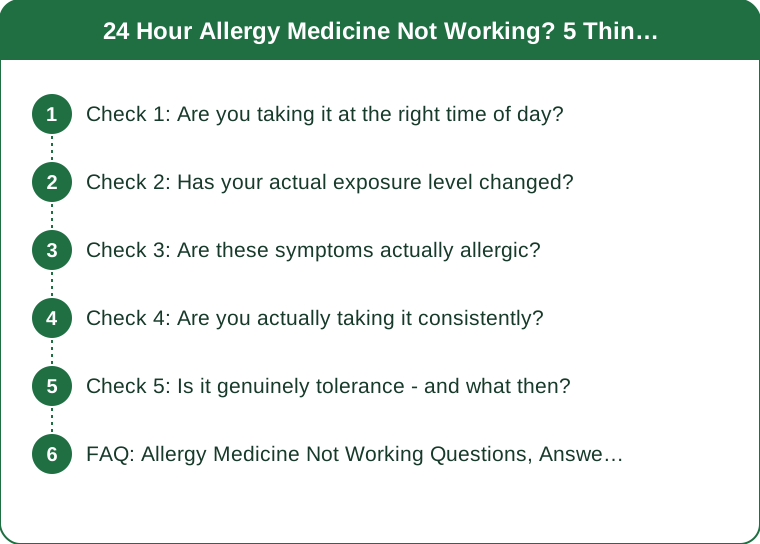
Check 1: Are you taking it at the right time of day?
This is the most common fix and the one almost nobody tries first.
Allergy symptoms follow a daily rhythm. For most people with seasonal or dust mite allergies, symptoms are worst in the early morning - between roughly 4am and 8am - because of both overnight allergen exposure in bedding and the natural circadian dip in the body’s own anti-inflammatory hormones.
A 24-hour antihistamine taken at 8am reaches peak blood concentration in the early afternoon and is at its lowest point roughly 20-24 hours later - which lands precisely on the following morning, when you need it most.
The fix: take it in the evening instead, around 7-9pm. Peak coverage then falls during the overnight and early-morning window when symptoms actually peak.
This single change resolves a meaningful share of ‘my medicine stopped working’ cases. Give it a full week before evaluating, since it takes a few days for the timing shift to fully settle. If your medication makes you drowsy, evening dosing is doubly sensible.
If you take it in the evening already and mornings are still bad, move to Check 2.
Check 2: Has your actual exposure level changed?
Medication effectiveness is relative to the size of the exposure. The same dose that handled a moderate pollen day will not handle a severe one, and that isn’t the medication failing.
Things that quietly raise exposure without you noticing:
- A high pollen season. Counts vary substantially year to year, and a bad year can double or triple the load on the same dose.
- Sleeping with the window open. Very common in late summer heat, and it puts you in direct overnight pollen exposure for eight hours.
- A new pet in the house or a friend’s pet visiting regularly.
- A change in your commute or route - a new walking path past different trees or grass.
- A bedroom that’s become dustier. Dust mite populations rise in humid conditions, which late summer supplies.
How to test this: check your local pollen count against the same week last year if that data is available, and track your symptoms alongside it for a week. If bad days line up with high counts, the medication is working - the load has just increased.
What to do about it: exposure reduction usually outperforms a medication switch. Closing bedroom windows overnight, showering before bed to remove pollen from hair, and washing bedding weekly at 60C address the load directly.
Check 3: Are these symptoms actually allergic?
A surprisingly large number of ‘my allergy medicine stopped working’ cases are symptoms an antihistamine was never going to address.
Antihistamines work well on: sneezing, itching (eyes, nose, throat, skin), and runny nose.
They work poorly or not at all on: nasal congestion and blockage, post-nasal drip, sinus pressure, and cough.
If your dominant symptom has shifted from sneezing and itching to blocked, stuffy congestion, an antihistamine will genuinely seem to have stopped working - because congestion is driven more by inflammation and vascular changes than by histamine.
What actually addresses congestion: intranasal corticosteroid sprays are the usual first-line option for that symptom pattern, and they work on a different mechanism entirely. They also take 3-7 days of consistent daily use before reaching full effect, which is why people often abandon them too early.
Other things that mimic allergy: non-allergic rhinitis (triggered by temperature changes, strong scents, or humidity), a lingering viral infection, and dry air irritation. None of these respond to antihistamines, and all are common in late summer.
This is worth a conversation with a pharmacist or doctor rather than a guess. This is general information, not medical advice.

Check 4: Are you actually taking it consistently?
Antihistamines work best taken daily and preventatively, not reactively when symptoms appear.
The common pattern: you take it on bad days and skip on good ones. This feels sensible and it undermines the medication substantially, because these drugs work by occupying histamine receptors before the histamine gets there. Starting after symptoms begin means playing catch-up against an already-triggered response.
The fix: during your symptomatic season, take it every single day at the same time, regardless of how you feel that morning. Set a phone alarm if needed - a missed dose two days ago is a plausible explanation for today being bad.
Also worth checking:
- Expiry date. Antihistamines lose potency over time, and a lot of people are working through a box bought two seasons ago.
- Storage. A bathroom cabinet is humid and warm - not ideal. A bedroom drawer is better.
- Whether you’re actually taking the dose on the box. Some people halve tablets to reduce drowsiness and then wonder why coverage dropped.
Track it for a week. A simple note on your phone each day - dose taken, time, symptom level 1-5 - reveals patterns that memory doesn’t.
Check 5: Is it genuinely tolerance - and what then?
If checks 1-4 come back clean, tolerance is worth considering, though it’s less common than the internet suggests for second-generation antihistamines.
The evidence for genuine antihistamine tolerance in the modern non-drowsy antihistamines is weaker than most people assume - much of what gets called tolerance turns out to be one of the four checks above. But individual variation is real, and some people do report a genuine reduction in effect over time.
If you and a pharmacist conclude it’s worth switching:
- Switching to a different molecule rather than a different brand of the same one is the point. Check the active ingredient on the box, not the brand name - many differently branded products contain the same drug.
- Give a new one at least two weeks of daily use before judging it.
- Don’t stack two antihistamines without medical guidance.
When to stop self-managing and see a doctor: symptoms interfering with sleep for more than two weeks, any wheezing or shortness of breath, symptoms that started suddenly without a clear seasonal pattern, or no improvement after working through all five checks. Allergy testing can identify what you’re actually reacting to, which turns guesswork into a targeted plan. This is general information, not medical advice.
FAQ: Allergy Medicine Not Working Questions, Answered
How long should I give a timing change before deciding it didn’t work?
A full week of consistent evening dosing. Shorter than that and you’re evaluating day-to-day pollen variation rather than the change you made.
Can I take my antihistamine twice a day if once isn’t enough?
Not without medical guidance. Doubling a 24-hour dose is a conversation for a pharmacist or doctor, not a self-adjustment.
Is it normal for the same medication to work one year and not the next?
Yes, and it’s usually the season rather than the medication - pollen counts and personal sensitivity both vary year to year.
Should I add a nasal spray or switch tablets first?
If congestion is your dominant symptom, a nasal steroid spray addresses something the tablet was never targeting. If sneezing and itching are dominant, work through the tablet checks first.
TL;DR:
- Take it in the evening, not the morning - symptoms peak between 4am and 8am
- A bad pollen year or an open bedroom window can outpace the same working dose
- Antihistamines don’t treat congestion; that needs a different mechanism entirely
- Daily preventative dosing beats reactive dosing on bad days
- True tolerance is less common than assumed - work through the first four checks first
Most people find the answer in check 1 or 2. This is general information, not medical advice.
Keep Reading
This article is for general informational purposes only and is not medical advice. Always consult a qualified health professional for guidance specific to you.