Five Autumn Allergy Routines That Actually Reduce Symptoms
Quick Answer: Autumn allergy symptoms come from three overlapping sources: ragweed pollen (peaking morning, roughly August to the first hard frost), outdoor mould spores from wet leaves (peaking afternoon and after rain), and indoor allergens stirred up when the heating starts. Five routines cover them: an evening shower and change, windows shut 5am to 10am, a filter change before first heating use, bedding at 130F weekly, and starting antihistamines two weeks before your usual onset.
Autumn allergies get less attention than spring ones and are frequently worse, partly because people do not expect them and partly because three different triggers arrive within a few weeks of each other.
The routines below are ordered by effect size, not by effort. The first one is the single highest-return change most people can make.
None of this replaces talking to a pharmacist or doctor, particularly if symptoms include wheezing or breathlessness. This is general information, not medical advice.
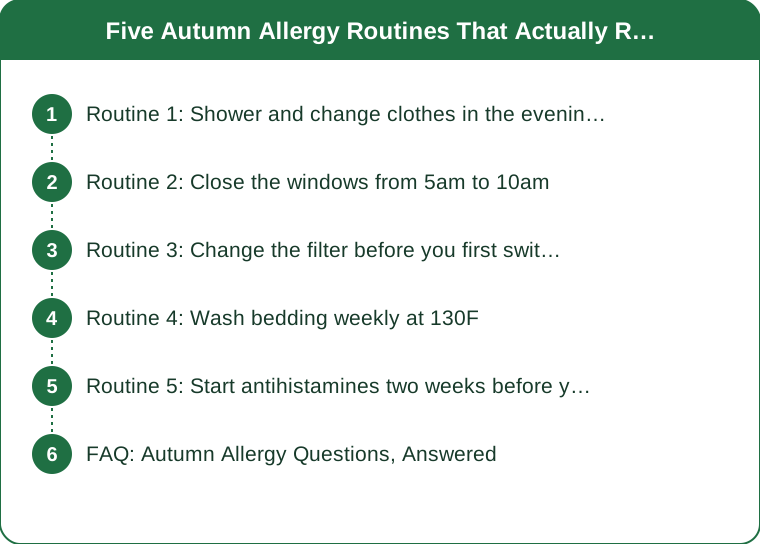
Routine 1: Shower and change clothes in the evening, not the morning
This is the highest-impact routine on the list and the one most people have backwards.
Pollen and mould spores collect on hair, skin and clothing all day. If you shower in the morning and go to bed in the evening without changing, you carry the entire day’s allergen load into the pillow you then breathe against for eight hours.
Shift the shower to the evening, or at minimum change out of daytime clothes and rinse your face and hair before bed. Hair matters more than people assume — it has a large surface area and sits directly next to your airway all night.
Two supporting details. Keep worn clothes out of the bedroom entirely, in a basket elsewhere in the house. And avoid drying laundry outdoors during ragweed season, because line-dried bedding collects exactly what you are trying to avoid.
People who make only this change often report a meaningful improvement in morning symptoms within a few days, because morning symptoms are frequently overnight exposure rather than that morning’s pollen.
Routine 2: Close the windows from 5am to 10am
Ragweed pollen release is strongly time-of-day dependent, and the peak is early.
Most ragweed pollen is released in the morning, with counts typically highest between roughly 5am and 10am on dry, breezy days. Sleeping with the window open through that window puts the highest concentration of the day directly into your bedroom.
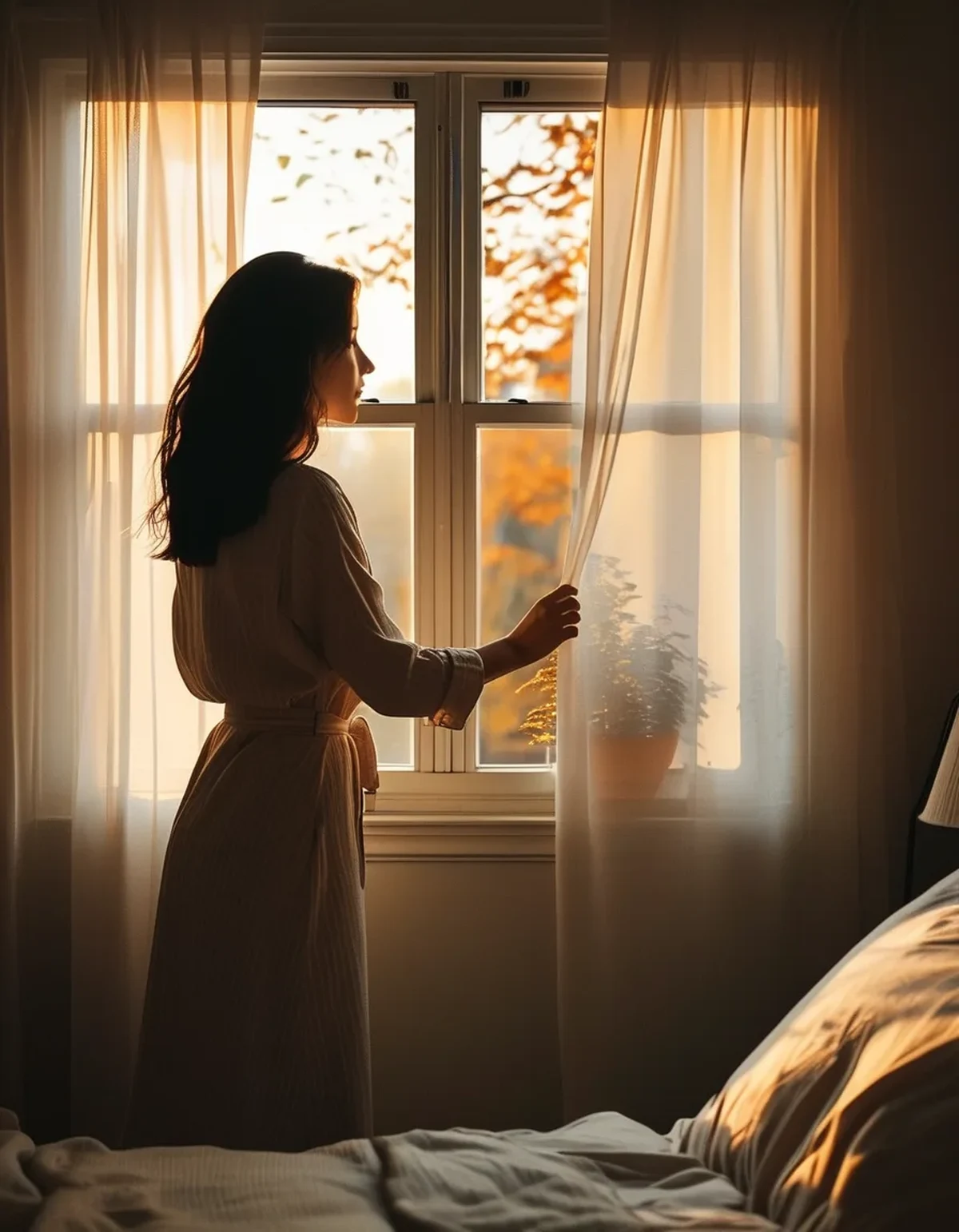
The practical routine: windows shut overnight and through the morning, open in the afternoon or evening if you want fresh air. This inverts what most people do by instinct.
Rain reverses the picture for pollen and worsens it for mould. Rain washes pollen out of the air, so a wet morning is a good morning to open windows. But the following day, wet leaves and damp ground produce a mould spore surge that peaks in the afternoon.
If you cannot control the windows — shared spaces, a bedroom that overheats — a small HEPA air purifier running in the bedroom overnight is the substitute. Size it for the room and run it continuously rather than on a schedule.
Routine 3: Change the filter before you first switch on the heating
The first day of heating is a reliable symptom spike, and it is almost entirely preventable.
Over a summer of disuse, dust, pet dander and mould settle in ducts, radiator surfaces and filter housings. The first hour of heating aerosolises all of it, which is why so many people develop symptoms in the same week the weather turns and blame the outdoor season.
Do three things before the first switch-on. Replace or wash the filter. Vacuum radiator fins and the tops of skirting boards, which is where the settled dust lives. Then run the heating for an hour with the windows open to flush the initial release outside rather than into your lungs.
For forced-air systems, a filter rated MERV 11 to 13 captures most common allergens without straining a domestic system. Higher is not automatically better — a filter that is too restrictive reduces airflow and can damage the unit.
Repeat the filter change every three months through the heating season. It is a ten-minute job with a disproportionate return.
Routine 4: Wash bedding weekly at 130F
Temperature is what matters here, and most household washes are too cool to do anything.
Dust mites and their allergens are destroyed at around 130F (54C). A 30C or 40C wash — the default on most machines and what most detergents recommend — removes some surface allergen and leaves the mites alive.
Wash sheets and pillowcases weekly at 130F or above. If your fabrics cannot take it, an alternative is a normal wash followed by 20 minutes in a hot tumble dryer, which reaches a comparable temperature.
Duvets and pillows matter too and are usually neglected. Wash or replace pillows every six months, and consider allergen-proof covers on both pillow and mattress — these are one of the few products in this space with genuinely good evidence behind them.
Indoor humidity is the lever underneath all of this. Dust mites and mould both need moisture. Keeping indoor relative humidity between 30 and 50 percent suppresses both, and a cheap hygrometer tells you where you actually are, which is often higher than expected once the heating and the closed windows arrive together.
Routine 5: Start antihistamines two weeks before your usual onset
Antihistamines work considerably better as prevention than as rescue, and almost everyone starts them too late.
The mechanism is straightforward: they block histamine from binding, so they work best when they are already present before the allergen arrives. Taking one after symptoms have started means playing catch-up against an inflammatory response already underway.
Look back at when your symptoms usually begin — most people can name the week — and start two weeks earlier. If you do not know, ragweed season in most of the northern US runs from mid-August to the first hard frost, so early August is a reasonable default.
Nasal corticosteroid sprays follow the same logic and are more effective than antihistamines for congestion specifically, but they take several days to a week to reach full effect. Starting them the day symptoms appear wastes the worst week.
Talk to a pharmacist about which category fits your symptoms, and see a doctor rather than self-managing if you have wheezing, chest tightness, breathlessness, or symptoms that are not controlled by over-the-counter options. Autumn is also peak season for asthma exacerbations, and that is not something to manage with antihistamines alone. This is general information, not medical advice.
FAQ: Autumn Allergy Questions, Answered
How do I tell an autumn allergy from a cold?
Allergies produce clear discharge, itching — particularly of the eyes, nose and throat — and no fever, and they persist for weeks with a daily rhythm. Colds bring body aches, sometimes fever, thicker discharge after a few days, and resolve in seven to ten days.
Does local honey help with ragweed?
There is no good evidence that it does. The pollens that cause allergic rhinitis are wind-borne, while honey contains flower pollen carried by bees, which is a different set of proteins.
Why are my symptoms worse indoors this month?
Almost certainly the heating. Closed windows, dry recirculated air and disturbed settled dust all arrive at once, and indoor triggers frequently overtake outdoor ones by late October.
TL;DR:
- Shower and change in the evening — morning symptoms are often overnight exposure from hair and clothing.
- Windows shut 5am to 10am during ragweed season; open them after rain instead.
- Change the filter and flush the system before the first heating use, then every three months.
- Wash bedding weekly at 130F and keep indoor humidity between 30 and 50 percent.
- Start antihistamines two weeks early; nasal steroid sprays need a week to reach full effect.
- See a doctor for wheezing, breathlessness or uncontrolled symptoms — this is general information, not medical advice.
Autumn allergies are three separate problems arriving together, which is why single fixes disappoint. Run all five routines for a fortnight and most people can identify which trigger was actually theirs.
Keep Reading
This article is for general informational purposes only and is not medical advice. Always consult a qualified health professional for guidance specific to you.