Five Car Setups That Cut Ragweed Pollen on Your Commute
Quick Answer: Your car pulls in outside air by default, and during ragweed season that means a concentrated pollen stream aimed at your face for the length of your commute. Five fixes handle almost all of it: replace the cabin air filter with a HEPA-rated one, use recirculate on tree-lined roads, run the fan before you get in, keep the interior surfaces clean, and change where your bag and jacket live. Total cost is usually under fifty dollars.
Ragweed peaks in early September and stays high until the first hard frost. If your symptoms are worst in the car and at work rather than at home, that is not coincidence - it is your ventilation system doing exactly what it was designed to do.
Here are five setups, in order of how much they help.

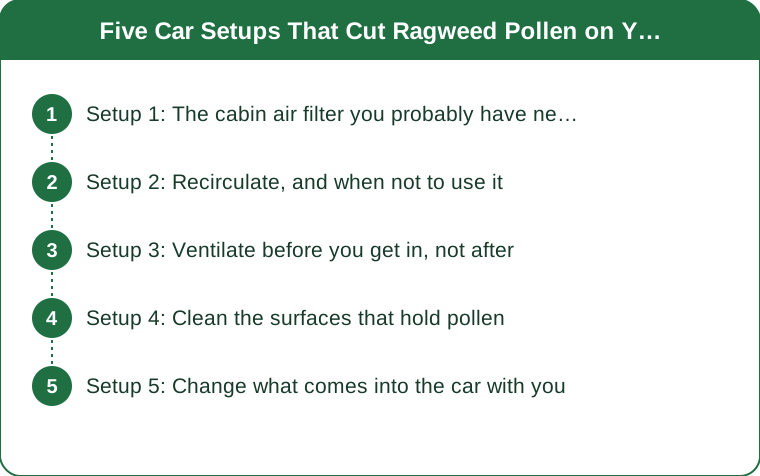
Setup 1: The cabin air filter you probably have never changed
This is the single biggest lever and most people do not know the filter exists. Nearly every car built since the late 1990s has a cabin air filter, usually behind the glovebox, and it is designed to be replaced roughly once a year. Most are on their original filter.
A clogged filter is worse than no filter for allergy purposes, because it reduces airflow so you turn the fan up, and a saturated filter sheds captured particles back into the stream. If yours is grey and holding leaf fragments, it has been passing pollen for a while.
Buy a HEPA-rated or activated-carbon cabin filter rather than the cheapest standard one. The difference is roughly fifteen dollars and the particle capture at pollen-sized ranges is substantially better. Ragweed pollen grains are around 20 microns, which is comfortably within what a decent filter catches - if the filter is clean.
The job takes ten to fifteen minutes in most cars and needs no tools. Drop the glovebox, slide the old one out, note the airflow arrow direction, slide the new one in. Search your specific model and year and there will be a video.
Do it now, at the start of the season, rather than in spring. A filter installed in September is at its most effective through the worst eight weeks of the year for ragweed.
Setup 2: Recirculate, and when not to use it
The recirculate button closes the outside air intake and cycles cabin air instead, which is the fastest single action available to you. With a clean filter, ten minutes on recirculate drops in-cabin particle levels considerably.
Use it on the parts of the drive that matter: tree-lined roads, roadside verges, anywhere near open fields, and behind anyone mowing. Roadside verges are ragweed’s favourite habitat, and a two-minute stretch alongside one can undo the previous twenty minutes.
Do not leave it on for the entire journey with the windows up and more than one person in the car. Carbon dioxide builds up over roughly twenty to thirty minutes and produces exactly the drowsiness you do not want while driving. Cycle it: recirculate through the bad sections, fresh air for a few minutes on open road.
Turn recirculate off when you demist. Recirculated air is more humid and will fog the windscreen faster. Fresh air and the air conditioning together clear glass much more quickly.
And remember it does nothing about pollen already in the car. Recirculate keeps new pollen out; the other four setups deal with what got in.

Setup 3: Ventilate before you get in, not after
A car parked outside overnight collects pollen on every surface, and the first thirty seconds of fan use blows a large portion of it into the cabin air. If you get in, start the engine, and turn the fan on, you are breathing that.
The fix is to run the fan on high, with the windows open and fresh air selected, for sixty to ninety seconds before you sit down. If your car has remote start, use it. If not, start it, open the doors, and load your bag while it clears.
Then close everything, switch to recirculate, and get in. You have moved the worst of it out of the car rather than into your face.
Where you park changes how much there is to clear. Under a tree is the worst option in autumn - falling debris and pollen concentrate there. An open space or a garage is significantly better, and a car cover on a driveway is a real improvement if you are badly affected.
This one costs nothing and takes ninety seconds, which is why it is worth building into the routine rather than doing on bad days.
Setup 4: Clean the surfaces that hold pollen
Pollen sticks to fabric and settles into vents, and it stays there. The dashboard, the vents, and the seats become a slow-release reservoir that recirculate cannot help with.
Vacuum the interior weekly during the season, seats and floors both. A cheap handheld unit is enough. Focus on the driver’s seat and headrest, which collect the pollen that comes off your hair and jacket every day.
Wipe hard surfaces with a damp microfibre cloth rather than a dry duster. Dry dusting lifts pollen into the air and it settles again. Damp capture removes it.
Do the vents specifically. A soft brush along the vent slats, then a damp wipe, clears the dust and pollen sitting where the air comes out. Most people never touch these.
And wash the outside of the car more often than usual in September. Pollen on the exterior around the windscreen cowl - the vented panel at the base of the windscreen - is drawn directly into the intake. That specific area is worth a rinse every week or two during peak season.
Setup 5: Change what comes into the car with you
Your bag, your jacket, and your hair are the delivery system, and the car is the place they get concentrated into a small volume.
Keep the gym bag and outdoor jacket in the boot rather than on the passenger seat. A jacket worn outdoors during ragweed season carries pollen on the fabric, and hanging it beside you on the headrest puts it directly in the airstream.
Keep a small pack of wipes in the door and use them on your hands and face before you drive after being outside. Hands transfer pollen to the steering wheel, the wheel transfers it back for the rest of the week.
If you exercise outdoors before commuting, change your top before getting in. This is the single highest-load item people bring into a car during ragweed season, because it is damp and it has been through moving air for an hour.
Do not dry laundry in the car or leave windows cracked at work. A window left open two inches at an office car park for eight hours during peak pollen undoes every other step on this list.
And put a hat and sunglasses in the door pocket. Both reduce how much pollen reaches your hair and eyes on the walk from the car to the door, which is when most people pick up the load they then bring inside.
This is general information, not medical advice. If your symptoms are severe, persistent, or include wheezing or shortness of breath, see a healthcare professional.
TL;DR:
- Replace the cabin air filter with a HEPA or carbon type - most people are still on the original, and it is the biggest single improvement for about fifteen dollars.
- Use recirculate through tree-lined roads and roadside verges, but cycle it rather than leaving it on for the whole journey.
- Run the fan with the doors open for sixty to ninety seconds before you get in, so the overnight pollen goes out instead of at you.
- Vacuum weekly, damp-wipe surfaces and vents, and rinse the windscreen cowl where the intake sits.
- Keep jackets and gym bags in the boot, wipe your hands before driving, and never leave a window cracked at work during peak season.
If your worst hour of the day is the drive home, start with the filter this weekend. It is the one on this list that keeps working without you thinking about it.
Keep Reading
This article is for general informational purposes only and is not medical advice. Always consult a qualified health professional for guidance specific to you.