5 Room-by-Room Looks at Cutting Allergens Where You Actually Spend the Most Time
Quick Answer: The 5 highest-exposure rooms for allergens are the bedroom, living room, bathroom, kitchen, and entryway — each has a different dominant allergen (dust mites, pet dander, mold, food particles, outdoor pollen) and needs a different fix, not one generic ‘clean more’ answer.
Most allergy-proofing advice treats the whole house the same. It shouldn’t — the bedroom’s biggest problem (dust mites in bedding) has almost nothing to do with the bathroom’s biggest problem (mold), and treating them identically wastes effort on the wrong fix in each room.

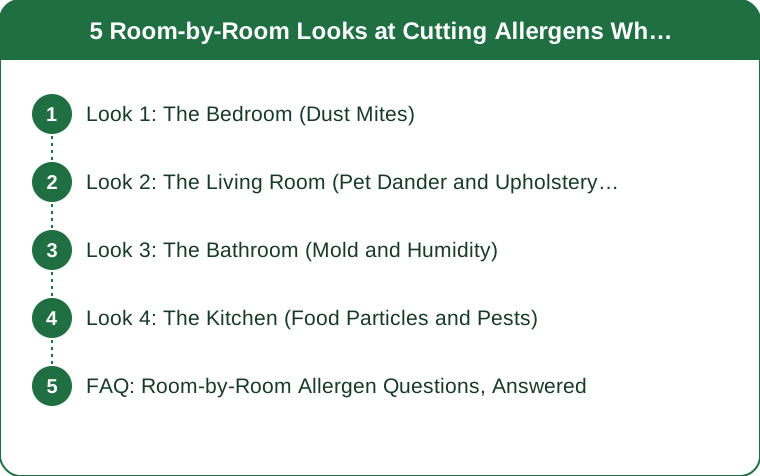
Look 1: The Bedroom (Dust Mites)
You spend 6-8+ hours here motionless, which makes it the single highest-exposure room for dust mites living in bedding, pillows, and mattresses.
Wash bedding weekly in hot water (130°F+), use allergen-proof mattress and pillow covers, and consider removing decorative pillows that just collect dust without functional use.
Look 2: The Living Room (Pet Dander and Upholstery Dust)
Fabric couches and rugs trap pet dander and general dust far more than hard surfaces, releasing it back into the air every time someone sits down.
Vacuum upholstery weekly with a HEPA-filter vacuum, and if pets are allowed on furniture, a washable throw over their favorite spot cuts embedded dander significantly.

Look 3: The Bathroom (Mold and Humidity)
Bathrooms run humid for hours after every shower, creating ideal conditions for mold growth in grout, shower curtains, and around windows — a different allergen category entirely from dust or dander.
Run the exhaust fan for 15-20 minutes post-shower, and wipe visible moisture off tile and curtains weekly to interrupt mold’s growth cycle before it establishes.
Look 4: The Kitchen (Food Particles and Pests)
Crumbs and food residue can attract pests whose droppings are a known allergen trigger, separate from any food allergy concern — this is an often-overlooked kitchen allergen source.
Wipe counters and sweep floors daily rather than every few days, and store dry goods in sealed containers instead of open bags or boxes.

FAQ: Room-by-Room Allergen Questions, Answered
Which single room makes the biggest difference to allergy symptoms if I only fix one?
The bedroom, since you’re exposed there for the longest continuous stretch — dust mite control in bedding alone often produces the most noticeable symptom change.
Do air purifiers help in every room equally?
They help most in rooms with the highest airborne particle load — typically bedroom and living room — and less in bathrooms, where humidity/mold is more of a surface issue than an air issue.
How often should allergen-focused cleaning actually happen?
Weekly for bedding and upholstery, daily for kitchen surfaces, and after-every-shower for bathroom humidity control — frequency should match how fast each allergen source rebuilds.
TL;DR:
- Bedroom (dust mites), living room (dander/dust), bathroom (mold), kitchen (food/pests) each need a different fix
- Wash bedding weekly in hot water — the single highest-impact room-specific change
- Run bathroom fans post-shower to interrupt mold’s growth window
- Match cleaning frequency to how fast each room’s specific allergen rebuilds
Generic ‘clean more’ advice misses that each room’s allergen problem is genuinely different — and so is the fix.
Keep Reading
This article is for general informational purposes only and is not medical advice. Always consult a qualified health professional for guidance specific to you.