Why Your Allergy Medicine Stops Working, the Local Honey Myth, and 3 Indoor Fixes
Quick Answer: Allergy medicine that stops working is usually not true tolerance - it’s more often a rising pollen count, a new trigger, or inconsistent daily use outpacing the dose. Local honey has not been shown in controlled studies to meaningfully reduce allergy symptoms. Indoor allergens respond best to 3 specific fixes: bedding, air filtration, and shoe-off entry habits.
Allergy advice tends to arrive in fragments - a tip here, a myth there. Here are the 3 questions people ask most, answered together in one place.

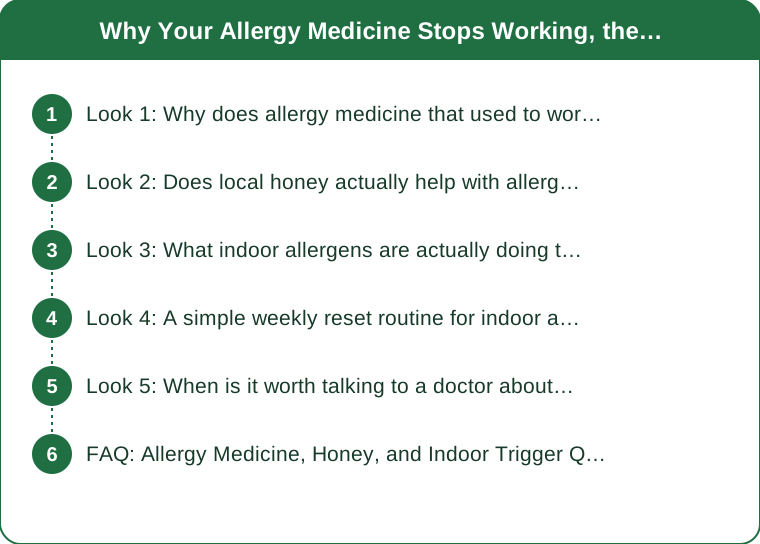
Look 1: Why does allergy medicine that used to work suddenly stop helping?
True pharmacological tolerance to antihistamines is uncommon. What’s far more likely: pollen counts spiked past what your current dose was ever designed to cover, you’re now reacting to a new seasonal trigger alongside your usual one, or you’ve been taking the medication inconsistently, which lets symptoms build back up between doses.
Switching to a different antihistamine class, or adding a nasal steroid spray alongside your current medication, often helps more than assuming the original one has simply quit working. [Photo: a woman reading a medication label in soft natural light]
Look 2: Does local honey actually help with allergies? The myth, tested
Myth: Local honey builds immunity to local pollen because it contains trace amounts of it. Fact: The pollen that triggers seasonal allergies is wind-pollinated (grasses, trees, ragweed), and bees collect a different type of pollen from flowers they visit - the specific pollen in your allergy trigger and the pollen in your honey jar are usually not the same. Controlled studies have not shown local honey to meaningfully reduce allergy symptoms.
Honey isn’t harmful to try and plenty of people enjoy it regardless, but it shouldn’t replace medication or be relied on as your main allergy management strategy. [Photo: a jar of local honey next to a cup of tea]
Look 3: What indoor allergens are actually doing the most damage?
Three specific spots create the bulk of indoor allergen exposure: your bedding (dust mites accumulate fastest here since you spend 7-plus hours in it nightly), your HVAC or air filter (a low-grade filter recirculates allergens instead of trapping them), and whatever you track in on your shoes (pollen and outdoor allergens ride inside on soles far more than most people realize).
Addressing these three specifically tends to matter more than a general ‘deep clean’ of the whole house. [Photo: a tidy bedroom with fresh bedding by a window]

Look 4: A simple weekly reset routine for indoor allergens
Wash bedding in hot water (130F+) weekly - this is the single highest-impact habit for dust mite allergens specifically, since mites and their waste don’t survive hot water washing. Replace or check your air filter monthly during high-pollen season rather than the standard 90-day cycle. Add a shoes-off policy at the door, which measurably cuts how much outdoor allergen gets tracked through the house.
A HEPA air purifier in the bedroom is a reasonable add-on if symptoms remain stubborn after these three habits are consistent for a few weeks. [Photo: a shoe rack by a front door with a small welcome mat]
Look 5: When is it worth talking to a doctor about changing medication?
If your current antihistamine genuinely isn’t controlling symptoms after 1-2 weeks of consistent daily use, or if you’re now dealing with new symptoms like facial pressure or wheezing, that’s the point to loop in a doctor rather than trying another over-the-counter option on your own. A doctor can check whether a different medication class, a combination approach, or allergy testing to identify new triggers makes sense.
This is general information, not medical advice - persistent or worsening symptoms deserve a professional evaluation rather than more guesswork. [Photo: a calm consultation setting, allergy medication and a glass of water on a table]

FAQ: Allergy Medicine, Honey, and Indoor Trigger Questions, Answered
How long should I give a new allergy medication before deciding it’s not working?
Most antihistamines need 1-2 weeks of consistent daily use to reach full effect - judging it after one or two doses is usually too soon.
Is there any evidence honey helps with any type of allergy?
Some very limited, small studies show mixed results, but nothing conclusive enough to recommend honey as a reliable allergy treatment over medication or other proven strategies.
What’s the single easiest indoor allergen fix to start with?
Washing bedding in hot water weekly is usually the easiest and highest-impact habit to start with - it requires no purchase and shows a difference within one to two weeks for many people.
TL;DR:
- Medicine ‘not working’ is usually rising pollen or inconsistent use, not true tolerance
- Local honey lacks solid evidence for allergy relief - it’s not harmful, just not proven
- Bedding, air filters, and a shoes-off habit are the 3 highest-impact indoor fixes
- Talk to a doctor if a consistent medication routine still isn’t controlling symptoms after 1-2 weeks
This is general information, not medical advice - persistent symptoms deserve a professional evaluation.
Keep Reading
This article is for general informational purposes only and is not medical advice. Always consult a qualified health professional for guidance specific to you.