5 Looks at What Actually Belongs in an Allergy Symptom Tracker
Quick Answer: Track date/time, symptom severity (1-10), suspected trigger, medication taken, and environment (indoor/outdoor, pollen count if available). Five fields, 30 seconds a day, and patterns that felt random usually surface within 2-3 weeks.
You know your allergies are “worse sometimes” but can’t pin down when or why. That vague sense is exactly what a simple tracker replaces with an actual pattern — and it only takes five things, not a full journal.

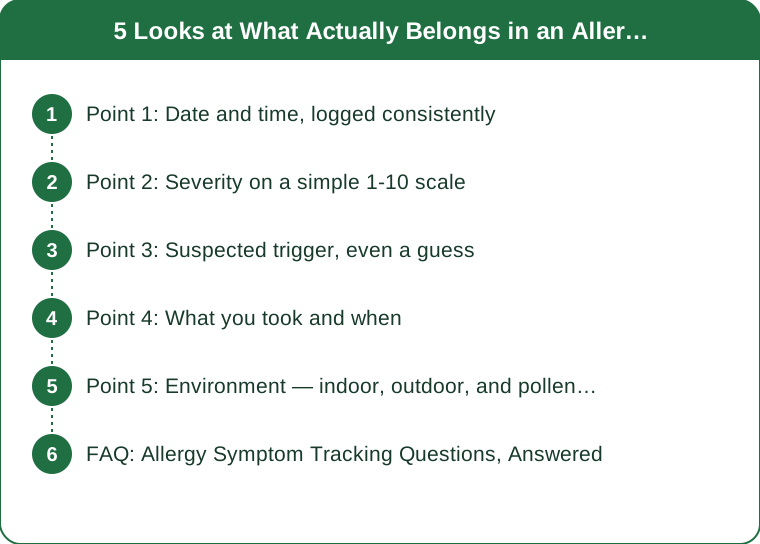
Point 1: Date and time, logged consistently
Log symptoms at the same 1-2 checkpoints daily (morning and evening works well) rather than only when symptoms flare. This catches the pattern of when symptoms are worst, which is often the fastest clue to the trigger — morning-heavy symptoms point toward bedroom allergens, evening-heavy toward outdoor exposure during the day.
Point 2: Severity on a simple 1-10 scale
Skip elaborate descriptions — a fast number is more useful long-term because it’s comparable week to week. A 3 today versus a 7 last Tuesday is instantly readable; three sentences of description mostly isn’t, once you’re scanning three weeks of entries.
Point 3: Suspected trigger, even a guess
Note what you were doing or near in the hours before symptoms started — even an uncertain guess is useful data once you have 15-20 entries to compare against each other and start seeing repeats.

Point 4: What you took and when
Log the medication, dose, and time taken. This reveals two things fast: whether a medication is genuinely working (compare severity trend before/after starting it) and whether timing is off (an antihistamine taken after symptoms peak works less well than one taken proactively before a known trigger window).
Point 5: Environment — indoor, outdoor, and pollen count if available
Most regions publish a daily pollen count — logging it alongside your severity score, even from memory of “high/medium/low” reported that day, often reveals the clearest single correlation in the whole tracker within just a couple of weeks.
FAQ: Allergy Symptom Tracking Questions, Answered
How long before a tracker shows a real pattern?
Most people notice their first clear pattern within 2-3 weeks of consistent daily logging — sooner if symptoms are frequent, longer if they’re sporadic.
Is a paper tracker fine, or do I need an app?
Either works — the format matters far less than the consistency. A sticky note on the fridge logged daily beats a fancy app used twice.
Should I bring my tracker to a doctor’s appointment?
Yes — a few weeks of the 5-field data above gives an allergist far more to work with than “it’s been bad lately,” and can meaningfully speed up figuring out your actual trigger.
TL;DR:
- Five fields: time, severity (1-10), suspected trigger, medication, environment
- A number is more comparable over weeks than a paragraph description
- Patterns typically surface within 2-3 weeks of consistent logging
- Bring the log to your doctor — it speeds up finding the real trigger
Keep Reading
This article is for general informational purposes only and is not medical advice. Always consult a qualified health professional for guidance specific to you.