5 Evening Steps That Decide How Your Allergies Feel at 6am
Quick Answer: Morning allergy symptoms are largely determined by your overnight exposure, and you control most of it in the two hours before bed. Shower and wash your hair to strip the day’s pollen, keep outdoor clothes out of the bedroom, close the windows before the evening pollen settle, run a HEPA filter through the night, and take a long-acting antihistamine at night rather than in the morning so peak coverage lands at dawn. Ragweed pollen peaks between roughly 6 and 10am, which is exactly when you are least able to do anything about it.
You go to bed fine and wake up with a face full of concrete. That is not your allergies getting worse - it is eight hours of uninterrupted exposure in the one room where you could most easily control it. Five steps, all in the evening, all cheap.
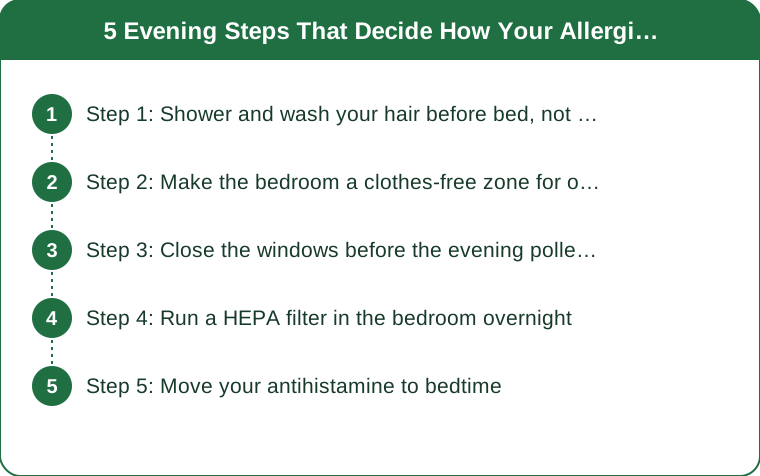
Step 1: Shower and wash your hair before bed, not in the morning
Pollen is sticky and your hair is a net. Ragweed and grass pollen grains cling to hair, eyebrows, and skin all day. If you shower in the morning, you spend the entire night transferring that load onto your pillow and breathing it from six inches away.
The evening shower moves the exposure window. Wash your hair - not just rinse it - and the pollen goes down the drain instead of into the pillowcase. This is the single highest-return step on the list for anyone with long hair, and the difference is usually noticeable within two nights.
Rinse your face and eyelashes deliberately. Eyelids and the skin around the eyes hold a surprising amount of pollen, which is part of why eye symptoms are so often worst in the morning. A gentle rinse plus a saline eye drop before bed handles it.
And do a saline nasal rinse if your symptoms are mostly nasal. A simple squeeze-bottle rinse with distilled or previously boiled water clears the pollen out of the nasal passages before eight hours of sleep press it against the tissue. Never use untreated tap water for nasal rinsing.
One practical note: if a full hair wash every night is not realistic, a shower cap plus a body rinse plus wiping the hairline with a damp cloth captures a good share of the benefit.
Step 2: Make the bedroom a clothes-free zone for outdoor wear
Everything you wore outside is carrying pollen. Dropping the day’s clothes on the bedroom chair puts that load in the room where you will spend the next eight hours breathing slowly and deeply.
Change and drop outside the bedroom. A hamper in the bathroom or hallway is the whole intervention. It costs nothing and removes a meaningful fraction of the overnight load.
The bag counts too. A gym bag, work tote, or backpack that sat on a train seat or a park bench is a pollen reservoir. Give it a home by the door.
Shoes especially. Shoe soles carry pollen, mold spores, and outdoor allergens indoors more efficiently than anything else you own. A no-shoes-inside rule is the cheapest air quality upgrade in the house.
And do not dry laundry outdoors during peak season. Line-dried sheets and towels in September are essentially pollen collectors, and they go straight onto your bed. Indoor drying or a dryer is worth the small energy cost through ragweed season.
Step 3: Close the windows before the evening pollen settle
Pollen behaves predictably through the day. Many wind-pollinated plants release in the morning; the grains rise with the warm air, then settle back down as the air cools in the evening. That evening settling is a second exposure peak most people never account for.
Close bedroom windows by late afternoon. If you have been airing out the house, do it in the middle of the day rather than in the evening, and close up before the temperature starts dropping.
Use air conditioning on recirculate if you have it. Cooling the room without pulling outdoor air in is the ideal combination. Check and change the filter - a clogged filter is not filtering.
If you cannot sleep without airflow, use a fan indoors rather than an open window. Moving indoor air feels nearly identical for sleep quality and does not import the outdoors.
And be realistic about the trade-off. Sleeping hot is genuinely bad for sleep quality, and bad sleep makes symptoms feel worse. If your only cooling is an open window, a bedside HEPA unit running through the night is the compromise - see the next step.
Step 4: Run a HEPA filter in the bedroom overnight
The bedroom is where filtration pays off most. You spend a third of your life there, motionless, breathing deeply, with your face near a surface that collects everything. A single HEPA unit in one room beats a whole-house approach on cost and effect.
Size it to the room and run it continuously. Look at the clean air delivery rate rather than the marketing claims, and choose a unit rated for a room larger than yours so it can run on a lower, quieter setting. Units run on high for an hour do far less than units run on low all night.
Position it away from the wall and off the floor if possible. Corners and floor placement restrict intake and cut effectiveness noticeably.
Add an allergen-proof pillow and mattress cover if dust mites are also in play. Ragweed season and indoor allergen season overlap in autumn, and many people who blame pollen alone are dealing with both.
Wash bedding weekly in hot water. This is the one place where hot water genuinely helps, because it is what kills dust mites. Pillowcases more often than that during peak season - they are the surface closest to your face.
Step 5: Move your antihistamine to bedtime
Timing matters more than most people realize. Second-generation antihistamines take roughly one to three hours to reach peak effect and are dosed for 24-hour coverage. Taking one at 8am means the peak lands mid-morning, after the worst of the dawn pollen has already triggered the response.
Take it in the evening and the peak coverage lands at dawn, when airborne ragweed counts are typically highest and when your own cortisol rhythm leaves you most reactive. The same pill, moved eight hours, often produces a noticeably better morning.
If you use a steroid nasal spray, use it consistently rather than reactively. These take days to reach full effect and are the most effective single treatment for nasal allergy symptoms, but only if used every day through the season rather than on bad mornings.
Do not double up to catch up. Skipping a day and taking two the next is not how these work, and some carry meaningful side effects at higher doses.
Track it for a week before deciding it failed. Note symptoms on waking on a 1 to 10 scale for seven days. Most people who believe their medication stopped working are actually dealing with an exposure problem in the bedroom that no pill was ever going to fix.
This is general information, not medical advice. Persistent symptoms, wheezing, or symptoms that interfere with sleep warrant a conversation with a doctor or allergist - and a proper allergy test tells you what you are actually reacting to, which changes the whole plan.
TL;DR:
- Shower and wash your hair at night so the day’s pollen goes down the drain instead of onto your pillow.
- Keep outdoor clothes, bags, and shoes out of the bedroom, and stop line-drying laundry through ragweed season.
- Close bedroom windows before the evening settle and air the house out at midday instead.
- Run a properly sized HEPA unit on low all night, and wash bedding weekly in hot water.
- Move your daily antihistamine to bedtime so peak coverage lands at the dawn pollen peak.
Morning symptoms feel like something happening to you. They are mostly the result of five decisions made the night before, and every one of them is inside your control.
Keep Reading
This article is for general informational purposes only and is not medical advice. Always consult a qualified health professional for guidance specific to you.