5 Gym and Studio Fixes for Allergy Season
Quick Answer: The five fixes that matter are timing your session away from peak pollen hours, choosing your spot away from doors and fans, wiping shared mats and equipment before use rather than after, changing and washing your hair after outdoor sessions, and pre-treating with your usual antihistamine roughly an hour before rather than after symptoms start. Indoor triggers - dust mites in mats, mould in changing rooms - are as relevant as pollen.
You vacuum, you keep the windows shut, you shower before bed. Then you go to a 6pm class where the doors are propped open onto a freshly mown lawn and a fan is aimed directly at your face.
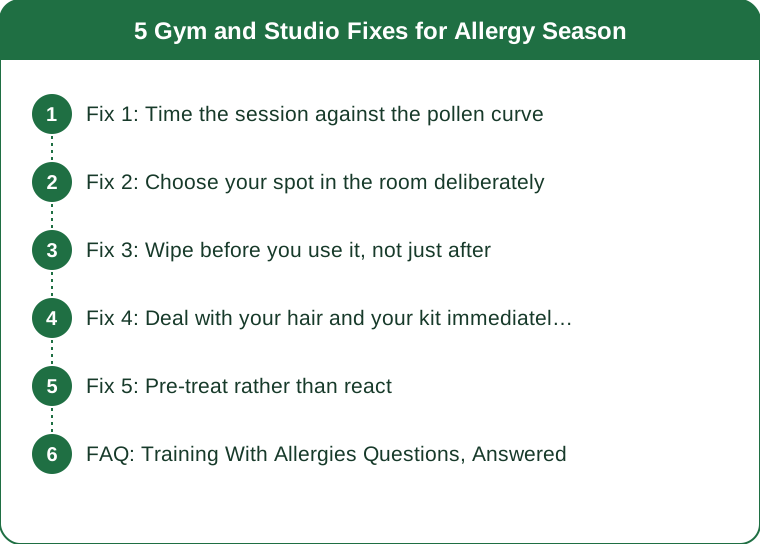
Fix 1: Time the session against the pollen curve
Pollen counts follow a fairly predictable daily pattern, and most people train at exactly the wrong hour without knowing it.
Grass and ragweed pollen typically peak from mid-morning to early afternoon, and again in the early evening as air cools and pollen that rose during the day settles back down. The lowest counts are usually late night and the first hours after dawn, and after rain.
The practical adjustment:
- Move outdoor sessions to early morning where you can
- Move indoor sessions into the late-afternoon and early-evening window instead of trying to run outside then
- Treat windy dry days as indoor days - wind lifts and carries pollen much further
- Use the day after rain for your outdoor session, not the day of - rain washes pollen out of the air temporarily
Check a local pollen forecast the night before rather than in the morning. Deciding at 6am rarely produces a plan; deciding the night before means the kit is packed for the right session.
One thing to know: exercise increases your breathing rate several-fold, so an hour of hard outdoor training during a high count delivers far more allergen to your airways than an hour of walking. Intensity multiplies exposure, which is why easy outdoor days and hard indoor days is a sensible allergy-season split.
Fix 2: Choose your spot in the room deliberately
Where you stand in a studio changes your exposure more than most people would guess.
Away from propped-open doors. A door onto a car park or lawn in summer is a direct pollen inlet, and the airflow through it is strongest right beside it. Move to the far side of the room.
Out of the direct fan line. Fans do not filter, they circulate - dust, mat particles, and whatever came in the door. Being downstream of a fan means everything gets delivered to your face at speed.
Away from stored mats and props. Stacked foam mats, bolsters, and blocks are dust-mite and dust reservoirs, and they get disturbed constantly. The corner by the prop shelf is the highest-dust part of most studios.
Not directly under an air vent that has visible dust on the grille - a good indication of what is being blown through it.
Away from carpet, if there is a choice. Carpeted studio areas hold far more allergen than hard floors.
For gyms specifically: cardio machine banks are usually near doors and fans, and running on a treadmill next to an open door on a high-pollen day is the worst combination in the building. Pick a machine away from the entrance even if it means a less interesting view.
Fix 3: Wipe before you use it, not just after
Everyone wipes down after. The wipe that protects you is the one before.
Shared mats are dust-mite habitat. Foam and vinyl mats stored stacked in a warm room, damp from the last user, are close to an ideal environment. Wiping the surface before you put your face on it for an hour of floor work is the single most useful thing on this list for anyone whose symptoms are worse indoors.
Bring your own mat where you can. It is the definitive fix, and it also lets you wash it properly - most home mats can be wiped weekly and given a proper wash monthly.
What to wipe, in order of return:
- The mat, especially where your face and hands go
- Bench and backrest pads on anything you lie on
- Handles and grips, which is hygiene as much as allergy
- Foam rollers, which are heavy dust collectors
Use your own wipes if the studio’s spray bothers you. Some cleaning sprays are respiratory irritants in their own right, and a fragranced disinfectant in a closed studio can produce symptoms that look exactly like an allergic response.
Wash your kit after every session, not every few. Pollen and dust cling to synthetic fabric, and a bag with damp used kit in it becomes a small mould culture within a day or two.
Fix 4: Deal with your hair and your kit immediately after
Pollen lands on hair and clothing and then follows you home, where it gets released onto your pillow. This is the mechanism behind the very common pattern of evening and overnight symptoms after a morning outdoor session.
Change out of training kit before you get in the car, or at least before you sit on soft furnishings at home. Kit into a bag, bag into the wash.
Wash your hair after outdoor sessions during high season. Hair, especially if it is long or product-treated, holds a surprising amount of pollen. If daily washing is not realistic, a damp cloth over the hairline and a change of pillowcase covers most of it.
Rinse your face and eyes. A quick cool rinse removes pollen from the skin around the eyes, which is where a lot of the itching originates. Saline eye drops help if your eyes are the main problem.
Do not lie on your bed in training kit. Obvious, universally ignored, and probably the single biggest source of overnight symptoms after a good morning outside.
Change the pillowcase more often in season. Twice a week during peak beats any evening antihistamine adjustment, and costs nothing.
Keep the gym bag out of the bedroom. A bag that goes from a damp changing room to the floor beside your bed is bringing both pollen and mould spores to the place you spend eight hours breathing.
Fix 5: Pre-treat rather than react
Most people take an antihistamine when symptoms start. Timing it ahead of exposure works better.
Take your usual non-drowsy antihistamine about an hour before training on a high-pollen day. Oral antihistamines generally take 30 to 60 minutes to reach useful levels, so taking one as you leave the house means you are unprotected for the first half of the session.
If you use a steroid nasal spray, consistency is what makes it work. These typically need several days to two weeks of daily use to reach full effect and are far less useful taken reactively. Starting before your local season rather than after symptoms arrive is what the labelling generally advises.
Know the difference between allergy symptoms and exercise-induced ones. Coughing, wheezing, chest tightness, or breathlessness that appears 5 to 15 minutes into exercise or shortly after stopping may be exercise-induced bronchoconstriction, which is common in people with allergies and needs a different treatment. That is a conversation with a doctor, not something to manage with antihistamines.
Warm up longer in allergy season. A gradual 10 to 15 minute warm-up is often better tolerated than going straight into hard efforts when your airways are already irritated.
When to stop and seek help: any significant difficulty breathing, wheeze that does not settle with rest, chest tightness, or lip and face swelling means stop and get medical attention. This is general information, not medical advice - if allergies are consistently limiting your training, that is worth a proper assessment rather than a workaround.
FAQ: Training With Allergies Questions, Answered
Is it better to train indoors during allergy season?
On high-count, windy days, generally yes. But indoor spaces have their own triggers - dust mites in mats, mould in changing rooms, cleaning-product irritants - so indoors is not automatically clear. Match the venue to what actually triggers you.
Can exercise make allergy symptoms worse?
It increases your breathing rate, so it increases how much allergen you inhale during the session. Regular exercise is generally beneficial overall; the fix is timing and venue rather than doing less.
Do face coverings help outdoors?
Some people find a light buff or mask reduces symptoms during outdoor sessions on high-count days. It is not a formal treatment but it is harmless to try, and easier to tolerate at low intensity than during hard efforts.
Why are my symptoms worse in a gym than outdoors sometimes?
Usually dust mites, mould, or cleaning-product irritants rather than pollen. If your symptoms are worse in one specific room and better outdoors, that points to an indoor trigger and is worth mentioning to a doctor.
TL;DR:
- Pollen peaks mid-morning to early afternoon and again early evening - train outdoors early or after rain
- Position yourself away from propped doors, fan lines, prop shelves, and dusty vents
- Wipe shared mats and pads before use, and bring your own mat if you can
- Change kit and wash hair straight after outdoor sessions, and change pillowcases twice weekly in season
- Pre-treat about an hour ahead rather than reacting, and use nasal sprays daily rather than as needed
Allergy season does not have to cost you a training block. Most of what makes it unbearable is timing, room position, and what you carry home in your hair - and all three are cheap to change.
Keep Reading
This article is for general informational purposes only and is not medical advice. Always consult a qualified health professional for guidance specific to you.