5 Late-Summer Allergy Adjustments Worth Making This Week
Quick Answer: Late summer allergy symptoms are usually driven by ragweed and outdoor mould rather than the grass pollen of early summer, and both peak at different times of day than people assume. The five adjustments that reliably help: shift outdoor exercise to the right window, change clothes and rinse hair on getting home, keep bedroom windows shut overnight, run a filter where you sleep, and start medication before symptoms rather than after.
You got through July and assumed you were clear. Then the second half of August arrived and it started again, with a slightly different character - more itchy eyes, more evening symptoms.
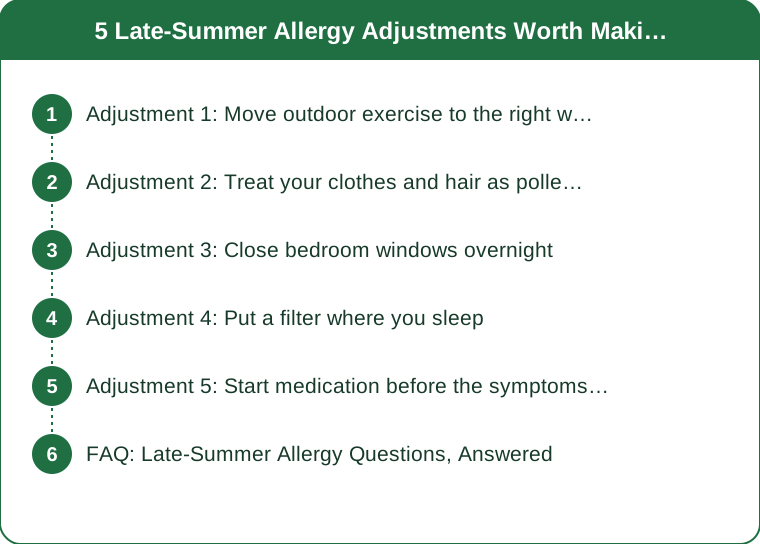
Adjustment 1: Move outdoor exercise to the right window
Timing changes exposure more than almost anything else you can control, and most people have the timing backwards.
Ragweed pollen typically peaks in the morning, often between around 6am and 11am, with counts rising as the day warms and air begins to move. That makes the popular 7am run one of the highest-exposure hours of the day during late summer.
Outdoor mould spores behave differently - they tend to rise in the afternoon and after rain, and they spike dramatically when anyone mows a lawn or disturbs damp leaf litter.
Practical windows:
- Late afternoon to early evening is often the best compromise for ragweed-sensitive people
- Immediately after sustained rain knocks pollen down temporarily, though it raises mould
- Avoid the hour after any nearby mowing, which is a bigger factor in a residential area than the daily count is
Expect a meaningful difference from this one. Shifting a daily outdoor session out of the morning peak is often the single highest-impact change available, and it costs nothing.
If the morning is the only time you have, that is a reasonable case for taking the session indoors during peak weeks rather than abandoning it.
Adjustment 2: Treat your clothes and hair as pollen carriers
Pollen sticks to fabric and hair, and then you carry it indoors and spend the evening next to it.
The routine, which takes about four minutes:
- Change clothes on getting home, and put the worn set straight into a laundry basket with a lid rather than draping them over a chair in the bedroom
- Rinse or wash your hair before bed on high-count days - hair holds a surprising amount, and you then press it into a pillow for eight hours
- Wash your face and rinse your eyes with cool water, which physically removes pollen from the areas producing the worst symptoms
- Shoes off at the door, which matters more for mould spores carried on soles than for pollen
Why the pillow point is the important one: if hair carrying pollen goes onto a pillow, you get eight hours of continuous close exposure at exactly the time your symptoms are already worst. People frequently report morning symptoms and assume it is an indoor allergen when it is yesterday’s outdoor pollen still on the pillowcase.
Wash bedding weekly in hot water during peak weeks, and pillowcases more often than that if you can. This is one of the highest-yield habits in the whole list.
Adjustment 3: Close bedroom windows overnight
This runs against the instinct to sleep with fresh air in warm weather, and it is worth doing anyway during peak weeks.
Why nights matter: pollen counts do not disappear after dark. Ragweed pollen released in the morning stays airborne and settles gradually through the evening and night, and cooling air can bring it back down to ground level. An open bedroom window on a late-summer night deposits pollen directly onto bedding and into the air you breathe for eight uninterrupted hours.
The compromise if the room gets too hot:
- Cool the room in the late afternoon with windows open, then close them before dusk
- Use a fan on a closed room rather than an open window
- Consider air conditioning on recirculate rather than fresh-air intake, if you have it
What to expect: people who make this change often report the clearest improvement in morning symptoms specifically - waking with less congestion and fewer itchy eyes. If your worst hour of the day is the first one, this adjustment targets it directly.
Car windows too, incidentally, with the ventilation set to recirculate during a commute through a high-pollen area.
Adjustment 4: Put a filter where you sleep
You spend roughly a third of your day in one room, which makes that room disproportionately worth treating.
What to look for: a HEPA filter rated for the room size, run continuously rather than in bursts. Filters work by processing room air repeatedly, so intermittent use gives much less benefit than the specification suggests.
Placement: near the bed, not in a corner behind furniture. Airflow path matters more than people assume.
Running it properly:
- Continuous on low beats intermittent on high, both for effectiveness and noise
- Windows closed while it runs, or you are filtering the outdoors
- Change filters on schedule - a saturated filter is close to useless and most people run them far past the recommended interval
Realistic expectations: a filter reduces airborne particulate in one room. It does not help with pollen already on your bedding, on your hair, or in the rest of the house. It works best stacked with adjustments 2 and 3, and fairly modestly on its own.
Also worth checking: home ventilation filters, if you have a central system, and vacuuming with a HEPA-filtered vacuum rather than one that redistributes fine particles back into the room.
Adjustment 5: Start medication before the symptoms, not after
This is the adjustment most commonly done wrong, and the timing genuinely changes how well it works.
Antihistamines work better preventively. Once the allergic cascade is underway and tissues are inflamed, a tablet takes longer to produce relief and often produces less of it. Starting one to two weeks before your usual seasonal onset and taking it consistently is a well-established approach.
Nasal corticosteroid sprays are the clearest example - they typically take several days to a couple of weeks of daily use to reach full effect. Used reactively on a bad day, they seem not to work, and people abandon them. Used daily through a season, they are among the more effective options for nasal symptoms.
Practical points:
- Consistency beats dose. Daily use at a standard dose outperforms occasional use.
- Technique matters for sprays - aiming slightly outward, away from the septum, and not sniffing hard afterwards
- Saline rinses before a medicated spray can help by clearing the passage first
Talk to a pharmacist or doctor about which option suits you, particularly if you take other medication, are pregnant, or have asthma - allergy symptoms and asthma interact, and worsening breathing during allergy season is worth medical attention rather than self-management. This is general information, not medical advice.
FAQ: Late-Summer Allergy Questions, Answered
Why do my symptoms feel different from early summer?
Different allergens. Early summer is largely grass pollen; late summer shifts toward ragweed and outdoor mould. The symptom profile often changes with it - many people notice more eye involvement and more evening symptoms in the late-summer phase.
Does rain help or hurt?
Both, at different times. Sustained rain washes pollen out of the air temporarily, which helps. The humid days afterwards raise outdoor mould spores, which is why some people feel worse two days after rain than during it.
Is it worth checking daily pollen counts?
Useful as a rough planning tool, less useful as a precise guide, since local conditions vary a lot from a regional figure. Your own symptom pattern over a couple of weeks is often a better predictor than the published number.
Can exercise make allergy symptoms worse?
Heavier breathing during exercise moves more air - and more allergen - through your airways, so outdoor sessions during peak hours do increase exposure. This is an argument for timing and location changes, not for stopping exercise, which has its own benefits.
When should I see a doctor rather than manage it myself?
If symptoms disrupt sleep or daily activity despite over-the-counter treatment, if you have wheezing or breathlessness, or if you are unsure whether it is allergy at all. Persistent symptoms are worth proper assessment, including allergy testing.
TL;DR:
- Late-summer symptoms usually come from ragweed and outdoor mould, not the grass pollen of early summer
- Move outdoor exercise out of the morning ragweed peak - often the single highest-impact change
- Change clothes and rinse hair before bed; pollen on a pillowcase gives you eight hours of exposure
- Close bedroom windows before dusk and run a HEPA filter continuously where you sleep
- Start antihistamines and nasal sprays before the season, and use them daily rather than reactively
None of these is dramatic on its own. Stacked, they change the total exposure and the total inflammation enough that late August stops feeling like a repeat of June. This is general information, not medical advice - persistent or breathing-related symptoms deserve a proper assessment.
Keep Reading
This article is for general informational purposes only and is not medical advice. Always consult a qualified health professional for guidance specific to you.