5 Ragweed Season Adjustments That Keep You Training Through August
Quick Answer: Ragweed pollen peaks in the late morning through midday and drops after rain, so training early or in the evening and checking daily counts handles most of the problem. The other four adjustments - showering immediately after, keeping windows closed during peak hours, taking antihistamines before symptoms rather than after, and moving intense sessions indoors on high-count days - cover the rest.
Ragweed season begins in mid-August across much of North America and runs until the first hard frost. That’s six to ten weeks of exactly the outdoor training season you wanted. Here’s how to keep it.
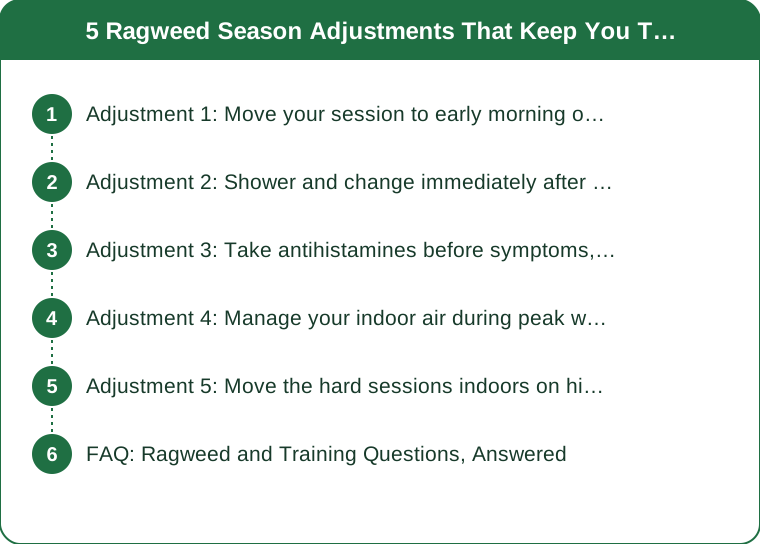
Adjustment 1: Move your session to early morning or evening
Timing is the single highest-impact change available, and it costs nothing.
Ragweed pollen release follows a daily rhythm. Plants release pollen in the morning, and airborne counts typically climb through late morning and peak around midday, then decline through the afternoon and evening.
That gives you two windows: early morning, before release has fully built, and evening, after counts have dropped. Both are also cooler in late summer, which is a second benefit for training quality.
Weather modifies the pattern. Dry, warm, breezy days produce the highest counts and spread pollen furthest. Rain temporarily clears the air, and the hours right after rainfall are often the best of the day for outdoor training - though counts can rebound quickly once things dry out.
Practical version: check a pollen forecast the night before, and treat a high-count midday as a signal to move the session rather than to skip it. Most training plans tolerate a time change far better than a missed day.
Adjustment 2: Shower and change immediately after training
Pollen sticks to skin, hair, and clothing, and then follows you indoors for the rest of the day.
This is why symptoms often peak in the evening for people who trained outdoors in the morning. The exposure didn’t end when the run did - it moved into your house, your sofa, and eventually your pillow.
The routine that works:
- Training clothes go straight into the laundry basket, not draped over a chair
- Shower including hair, especially if your hair is long or you trained on a windy day
- Rinse your face and eyes with cool water even if a full shower isn’t possible
The pillow point matters more than people expect. Hair carries a surprising amount of pollen, and eight hours of face contact with a pollen-loaded pillowcase is a meaningful exposure. If you can only do one thing on this list, wash your hair before bed on training days.
Sunglasses during outdoor sessions are a small addition with a real effect - they physically reduce pollen reaching the eyes, which is where many people’s worst symptoms sit.
Adjustment 3: Take antihistamines before symptoms, not after
This is the adjustment most people get wrong, and the difference is substantial.
Antihistamines work by blocking histamine receptors, which means they prevent a reaction more effectively than they reverse one already underway. Taking one after your eyes are streaming is treating a response that has already released its mediators.
The common guidance for seasonal allergy management is to start regular medication before or at the beginning of the season and continue it consistently rather than reactively. For ragweed, that means starting in early to mid-August rather than at the first bad day.
Timing within the day matters too. Many people take a daily antihistamine in the evening, which is convenient and also means peak effect lands overnight rather than at midday.
Important caveats: which medication suits you, whether a nasal steroid spray is more appropriate, interactions with anything else you take, and whether allergy testing or immunotherapy is worth considering are all questions for a doctor or pharmacist. Some antihistamines cause drowsiness that affects training. This is general information, not medical advice - and if symptoms are affecting your breathing during exercise, that specifically warrants a medical conversation rather than self-management.
Adjustment 4: Manage your indoor air during peak weeks
You spend far more hours indoors than training, so indoor exposure often drives your overall symptom load.
Keep windows closed during peak pollen hours - late morning through afternoon. Late August is exactly when open windows feel most appealing, which is the conflict.
If you use air conditioning, it recirculates and filters, which helps considerably. Check and replace filters at the start of the season.
Consider a HEPA air filter in the bedroom specifically. Bedrooms are where you spend the most continuous hours, and improving one room is far more achievable than improving a whole house.
Dry laundry indoors during ragweed season. An outdoor line collects pollen efficiently, and then you sleep on it or wear it.
Change your bedding more frequently during peak weeks - weekly rather than fortnightly makes a noticeable difference for people whose symptoms are worst in the morning.
And vacuum with a HEPA-filtered machine if you have one. Standard vacuums can redistribute fine particles rather than capture them.
Adjustment 5: Move the hard sessions indoors on high-count days
Not all training is equally affected, and this is where most people over-correct in one direction or the other.
Intensity increases exposure. Hard efforts mean higher breathing volume, more mouth breathing rather than nose breathing, and therefore substantially more pollen reaching the lower airways. An easy 40-minute walk and a hard interval session are not the same exposure, even outdoors on the same day.
The practical split:
- High count day: move intervals, tempo work, and anything hard indoors. Keep easy outdoor sessions if you tolerate them.
- Moderate count day: train outdoors with the timing and shower adjustments.
- Low count or post-rain: train normally, and take advantage of it.
Nose breathing filters better than mouth breathing - the nasal passages trap a meaningful share of larger particles. That’s an argument for keeping easy sessions genuinely easy enough to breathe through your nose during ragweed weeks.
And don’t stop training. Exercise remains beneficial and the goal here is adaptation, not avoidance. The people who fare worst across a ragweed season are usually the ones who abandon training entirely in mid-August and lose eight weeks of fitness alongside the symptoms.
FAQ: Ragweed and Training Questions, Answered
How long does ragweed season last?
Typically mid-August until the first hard frost, which means six to ten weeks depending on your latitude and the year.
Does local honey help with ragweed allergy?
There’s no good evidence that it does, and the pollen involved in honey production is largely not the wind-borne pollen that causes seasonal symptoms.
Can exercise itself make allergy symptoms worse?
Higher breathing volume increases exposure, yes. Regular exercise is generally beneficial overall - the adjustment is when and where, not whether.
Should I wear a mask outdoors?
Some people find it helps, particularly for easy sessions on high-count days. It’s uncomfortable for hard efforts, which is where you’d want the protection most - which is why moving those sessions indoors usually works better.
TL;DR:
- Train early morning or evening; midday counts are highest, and post-rain hours are best
- Shower and change straight after outdoor sessions, and wash your hair before bed
- Start antihistamines before the season, not after symptoms begin - and check with a pharmacist
- Keep windows closed at peak hours, filter the bedroom, dry laundry indoors
- Move hard sessions indoors on high-count days; keep easy outdoor ones
Ragweed season is six to ten weeks long. Adjusting beats skipping it.
Keep Reading
This article is for general informational purposes only and is not medical advice. Always consult a qualified health professional for guidance specific to you.