5 Ways to Cut Ragweed Pollen Exposure Before It Gets Inside
Quick Answer: Ragweed pollen peaks in late summer through autumn and travels long distances on the wind, so avoiding outdoor exposure entirely is not realistic. The bigger win is stopping it accumulating indoors: change clothes and shower at the end of the day, keep bedroom windows shut during peak hours, wash bedding weekly in hot water, filter the air where you sleep, and keep pollen off pets and out of laundry. Reducing your night-time load matters more than any single daytime measure.
Most people fight this season outdoors and then sleep for eight hours in a room they carried the pollen into.
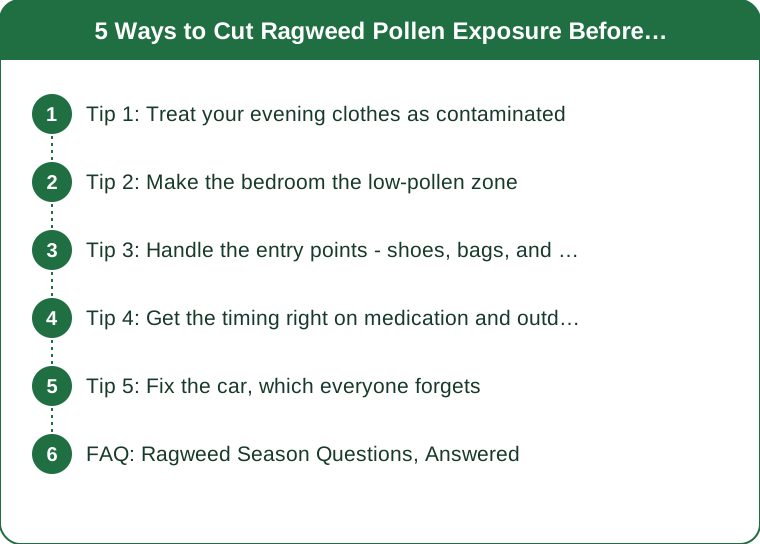
Tip 1: Treat your evening clothes as contaminated
This is the single highest-impact change, and it costs nothing.
Ragweed pollen is small, light, and sticky. It lands on fabric and hair through the day and it stays there. When you come home and sit on the sofa in the same clothes, you are transferring the day’s collection onto the furniture you use all evening. When you go to bed without washing your hair, you are putting it directly onto the pillow you will breathe against for eight hours.
The routine that works:
- Change out of outdoor clothes at the door, or at least before sitting on soft furniture. Put them straight into a laundry basket with a lid, not draped on a chair.
- Shower in the evening rather than the morning, and wash your hair if you have been outside for any length of time. Hair holds a surprising amount.
- Rinse your face and eyes even on days you do not wash your hair. Eyelashes and eyebrows collect pollen efficiently.
Why evening beats morning: a morning shower removes pollen you have not accumulated yet and leaves you clean for a day of collecting more. An evening shower removes the day’s load before you spend the longest continuous stretch of time in one room. If you only do one, do the evening one.
Tip 2: Make the bedroom the low-pollen zone
You spend more consecutive hours there than anywhere else, and it is the easiest room to control.
Close the bedroom window during peak hours. Ragweed pollen counts are typically highest from mid-morning through early afternoon, with a secondary rise as air cools in the evening. If you need airflow, open windows late at night or very early, and keep them shut through the middle of the day.
Wash bedding weekly at a hot wash. Pillowcases more often if you can - twice a week through the peak weeks is genuinely worth it. Pollen that ends up on the pillowcase is being breathed in for the whole night at very close range.
Do not dry bedding or clothes outdoors during the season. This is the one people resist because line drying is pleasant and cheap. A sheet hung outside on a high-pollen day comes in loaded, and you then sleep on it. Use an indoor rack or a dryer through peak weeks.
Keep the door shut so the room does not equalise with the rest of the house all day.
Consider a HEPA filter for the bedroom specifically. One unit in the room where you sleep does more than a whole-house approach for most people, and it is far cheaper.
Tip 3: Handle the entry points - shoes, bags, and pets
Pollen does not blow in through walls. It walks in.
Shoes off at the door. Outdoor shoes carry pollen from pavements and grass verges directly onto the floors you sit on. This is a small habit with a disproportionate effect on the whole-house load.
Bags and coats off the bed and the sofa. A gym bag that sat on grass and then sits on the bed puts the entire day’s outdoor exposure right where you sleep.
Pets are the biggest uncontrolled source in most homes. A dog that has been in long grass comes back coated, and then sits on the sofa and the bed. Wipe them down with a damp cloth after walks - focus on the belly, legs, and ears where pollen accumulates. Do it outside or at the door.
Time the dog walks. Early morning or later evening walks catch lower counts than mid-morning ones. If your dog needs a mid-day walk, prioritise the wipe-down afterwards.
Wipe surfaces with a damp cloth rather than dusting dry. Dry dusting lifts settled pollen back into the air, where you breathe it. Damp cloths capture it.
Tip 4: Get the timing right on medication and outdoor activity
Exposure reduction only takes you so far. The timing of what you take and when you go out fills the rest of the gap.
Start antihistamines before the season, not during it. Many people begin taking something after symptoms arrive, which means playing catch-up against an already-triggered response. Discussing a pre-season start with a pharmacist or doctor is one of the most common pieces of practical advice in this area.
Check the local pollen forecast and plan around it. Counts vary substantially day to day with wind and humidity. A high-count, dry, windy day is one to move the outdoor run indoors; a day after steady rain is often noticeably easier.
Exercise outdoors early or late. Peak counts through the middle of the day coincide with when many people train. Shifting a run to early morning can meaningfully reduce exposure, and it matters more for exercise than for other activities because you are breathing far more air, more deeply, through your mouth.
Wear wraparound sunglasses outdoors. They physically reduce how much pollen reaches your eyes, and eye symptoms are what most people find hardest to tolerate.
Any medication decision, especially with existing conditions or other prescriptions, is one to run past a professional. This is general information, not medical advice.
Tip 5: Fix the car, which everyone forgets
The car is a small, sealed box you spend concentrated time in, and it is usually the worst-managed space in the whole picture.
Use recirculate, not fresh air intake. The fresh air setting draws outside air, and outside air in September is what you are trying to avoid. Recirculate mode uses the air already inside, filtered.
Change the cabin air filter. Most cars have one, most people have never changed it, and a clogged filter passes far more through. Some cars accept a HEPA-grade replacement, which is a genuinely worthwhile upgrade for one season of use.
Keep windows shut and use the air conditioning. Driving with the windows down on a high-count day fills the car with pollen that then settles into the upholstery and stays.
Vacuum the interior during the season. Seats and carpets accumulate pollen the same way sofas do, and you are sitting in close contact with them.
Do not leave the car windows cracked open while parked on warm days - a car left open near grass for an afternoon becomes a pollen trap you then get into.
Same principle as everywhere else: the goal is not zero exposure, it is reducing the hours you spend marinating in the load you already collected.
FAQ: Ragweed Season Questions, Answered
When does ragweed season actually end?
It typically runs from late summer into autumn and ends with the first hard frost in colder regions. In milder areas it can persist well into autumn, which surprises people who expect relief in September.
Does rain help or hurt?
Steady rain washes pollen out of the air and usually brings relief. A brief shower followed by wind can be worse, since it can break particles up and stir them around. The most reliably difficult days are dry, warm, and breezy.
Are air purifiers worth the money?
A HEPA unit in the bedroom is the best value version of this. Whole-house approaches cost far more for less benefit per pound, because the bedroom is where you spend the most continuous time.
Should I still exercise outdoors during peak season?
For most people yes, with timing adjustments - early morning, lower-count days, and a shower afterwards. If exercise triggers significant breathing symptoms, that is worth discussing with a healthcare professional rather than working around. This is general information, not medical advice.
Can local honey help with ragweed allergy?
The popular claim does not hold up well - the pollen in honey is largely from flowering plants that insects visit, not the wind-borne pollen that causes seasonal allergy. It is a pleasant thing to eat, not a treatment.
TL;DR:
- Evening shower and clothes change beats every daytime measure - it protects the eight hours you sleep
- Keep the bedroom window shut during peak hours, wash bedding hot and weekly, dry indoors
- Shoes off, bags off the bed, wipe the dog down after walks
- Start medication before the season, train early or late, wear wraparound sunglasses
- Use recirculate in the car and change the cabin filter nobody ever changes
Ragweed season is not really won outdoors. It is won by making sure the pollen you inevitably collect during the day does not follow you into the room where you spend the next eight hours. This is general information, not medical advice.
Keep Reading
This article is for general informational purposes only and is not medical advice. Always consult a qualified health professional for guidance specific to you.