5 Signs Your Allergy Management Is Actually Working (Even If You Still Sneeze Sometimes)
Quick Answer: Fully symptom-free is rarely the realistic goal for allergy management — better markers are fewer flare days, milder reactions, less reliance on rescue antihistamines, and faster recovery after exposure, all of which can improve even while occasional sneezing stays.
You started the air purifier, the saline rinse, the daily antihistamine, and you still sneeze sometimes. It’s tempting to conclude none of it is working. That conclusion is usually wrong — you’re just measuring against the wrong bar.

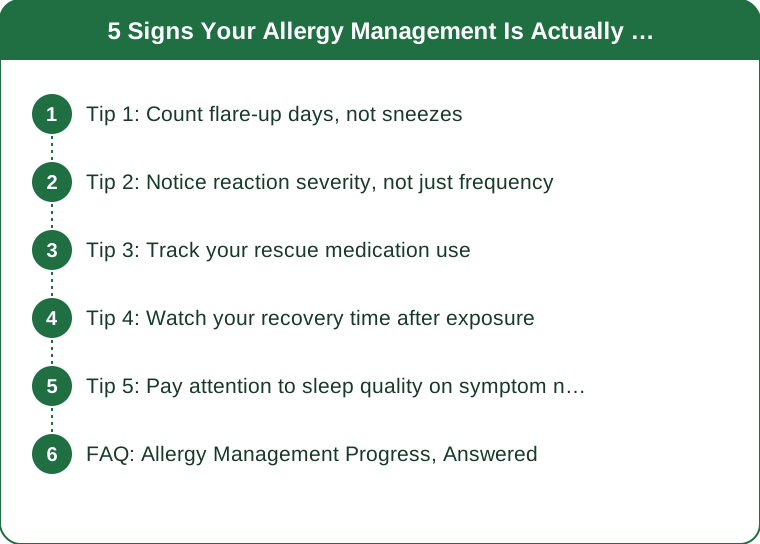
Tip 1: Count flare-up days, not sneezes
One sneeze on a high-pollen day isn’t a failure. Track how many days per week involve real symptoms versus a passing moment. A drop from 5 flare days a week to 2 is a real, measurable win, even with occasional sneezing still present.
Tip 2: Notice reaction severity, not just frequency
If a trigger used to mean a full day of congestion and now means an hour of mild stuffiness, that’s your management working — severity dropping is just as meaningful as frequency dropping, and often shows up first.
Tip 3: Track your rescue medication use
If you’re reaching for antihistamines or rescue inhalers less often than a month ago, that’s a concrete, trackable sign of improvement — write it down weekly rather than trusting memory alone.

Tip 4: Watch your recovery time after exposure
Getting hit with a trigger and bouncing back in 30 minutes instead of the rest of the day is a real sign your baseline inflammation is lower than it used to be, even if the initial reaction still happens.
Tip 5: Pay attention to sleep quality on symptom nights
Allergies disrupting sleep is one of the most disruptive parts of a bad flare. If symptom nights are still happening but you’re sleeping through them better than before, that’s a meaningful, easy-to-miss improvement.
FAQ: Allergy Management Progress, Answered
Should I expect to be completely symptom-free eventually?
For many people, no — reduced frequency and severity is a more realistic, sustainable goal than total elimination, especially with environmental allergies.
How long before allergy management shows results?
Some interventions (like air purifiers) show effects within days; others (like allergy medication adjustments) can take several weeks to fully assess.
When should I see a doctor instead of just tracking?
If flare days and severity aren’t trending down after a few weeks of consistent management, or symptoms are worsening, it’s worth a professional reassessment rather than continuing to wait it out.
TL;DR:
- Count flare-up days and severity, not individual sneezes
- Falling rescue medication use is a real, trackable improvement sign
- Faster recovery after exposure means lower baseline inflammation
- Total symptom-free isn’t always realistic — trending better is the actual goal
This is general information, not medical advice — track your own patterns and loop in a doctor if things aren’t trending down.
Keep Reading
This article is for general informational purposes only and is not medical advice. Always consult a qualified health professional for guidance specific to you.